

Truzio Explained: What It Is, How It Works, and Whether It’s Worth Using 2026

If you’ve landed here after typing “Truzio” into Google, you’ve probably noticed something odd: the search results are a mixed bag. Some point to a small data-validation SaaS tool. Others point to an entirely different company an IT staffing firm in India with Glassdoor reviews from employees. That mix-up alone causes real confusion, and it’s the first thing worth clearing up before anything else.
This guide focuses on Truzio (truzio.co), the data verification and enrichment platform, since that’s almost always what people evaluating a product are actually looking for. You’ll get a plain-language explanation of what it does, how its phone, email, IBAN, and IP validation tools work, what it actually costs under its “DataCoins” pricing model, how secure it appears to be, and just as importantly what’s still unproven about it, since it’s a relatively new brand without a long public track record.
By the end, you’ll know exactly whether Truzio fits your use case, how it compares to more established validation tools, and what to check before you commit any budget to it.
What Is Truzio?
Truzio is a web-based data verification and enrichment platform built for businesses that need to clean up, validate, or enhance datasets things like customer contact lists, payment details, or sign-up forms full of messy or fake information.
It’s operated by LENTRAX LTD, a company registered in London, England (Companies House number 17197905). That’s a meaningful trust signal on its own: the business behind Truzio isn’t anonymous its legal entity, registration number, and registered address are published on the site, which is more transparency than a lot of small SaaS tools offer.
At its core, Truzio solves a problem almost every sales, marketing, fintech, or e-commerce team eventually runs into: your data is only as useful as it is accurate. A phone number that bounces, an email that doesn’t exist, or an IBAN that’s malformed can quietly break outreach campaigns, payment flows, or compliance checks. Truzio positions itself as a straightforward way to catch those problems before they cost you money or credibility.
Key Takeaways about truzio
- Truzio (truzio.co) is a UK-registered, pay-as-you-go data validation and enrichment platform covering phone, email, IBAN, and IP/company data.
- It runs on a “DataCoins” credit system at €0.98 per 100 coins, with tool costs starting between 100–150 coins per operation.
- It’s operated by LENTRAX LTD, a legally verifiable UK company, and displays PCI-DSS compliance and a published DPA solid baseline trust signals.
- The main honest caveat: it’s a young brand with limited independent review history, so test with a small batch before scaling up.
- There is a completely unrelated company also called “Truzio” (an India-based ERP/IT staffing firm) make sure you’re looking at the right one.
See More: Spicy Chat AI Review 2026: What 300,000 Characters and Three Paywalls Actually Get You
How Truzio Works (Step by Step)
Unlike enterprise data platforms that require API integration or developer resources, Truzio is built around a simple, self-serve workflow:
- Pick a tool. Choose from phone number validation, email validation, IBAN validation, or IP geolocation/company enrichment.
- Upload your data. You download a template file, drop your data into it, and upload it to the platform (there’s no need to build an integration for basic use).
- Download the cleaned file. Truzio processes the batch and returns an updated file with validated, enriched, or flagged records.
This file-in, file-out approach is aimed squarely at non-technical users marketing ops, finance, and operations teams who need clean data fast and don’t want to involve engineering for a one-off cleanup job. It’s worth noting that this also means Truzio is better suited to batch, periodic cleanups than to real-time validation (like checking a phone number the instant someone types it into a signup form). If you need real-time, in-app validation, you’d typically be looking at an API-first tool instead more on that in the alternatives section below.
Truzio’s Core Tools and Features
Here’s a breakdown of what’s actually available on the platform:
| Tool | What It Does | Typical Use Case | Starting Price |
| Phone Number Validation | Checks whether a phone number is real, active, and correctly formatted | Cleaning CRM contact lists before a sales/SMS campaign | 120 DataCoins |
| Email Validation | Verifies whether an email address is deliverable and catches typos, disposable addresses, and dead inboxes | Improving email deliverability and sender reputation before a campaign | 120 DataCoins |
| IBAN Validation | Confirms that an International Bank Account Number is structurally valid before a transaction | Reducing failed payments and fraud risk in fintech/payments workflows | 150 DataCoins |
| IP Geolocation / Company Enrichment | Adds geographic and company-level context to an IP address or dataset | Fraud screening, lead qualification, localizing content | 100 DataCoins |
A few things stand out here. First, Truzio deliberately keeps its scope narrow it isn’t trying to be an all-in-one CRM enrichment suite like Clearbit or a full identity-verification platform like Trulioo. It’s a set of focused, single-purpose validation utilities. Second, the pricing being denominated per-tool rather than a flat platform fee means your total cost depends heavily on which combination of tools you actually need which brings us to pricing.
Truzio Pricing Explained: How “DataCoins” Actually Work
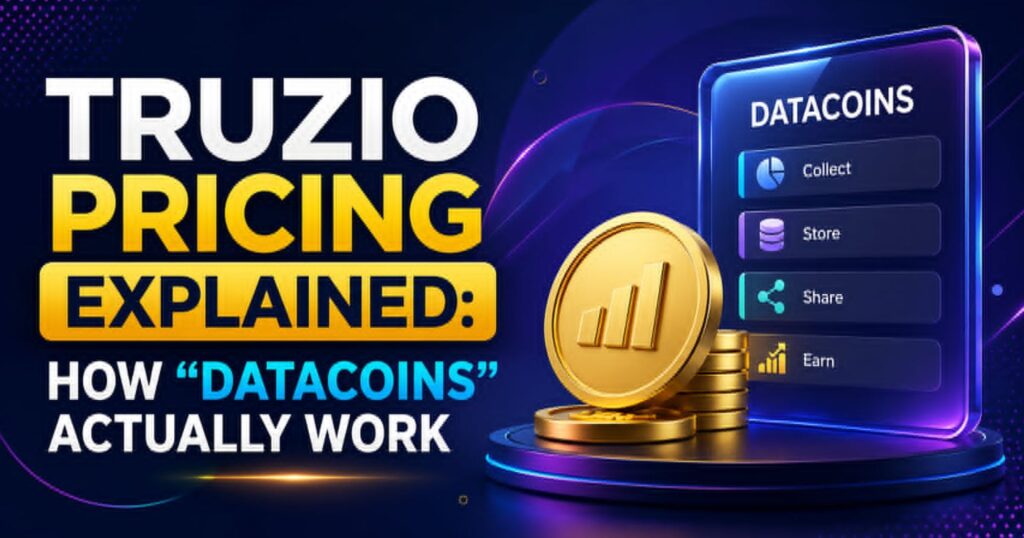
Truzio uses a pay-as-you-go credit system called DataCoins instead of a monthly subscription. Here’s the exact math:
- €0.98 per 100 DataCoins, purchased in the exact quantity you choose.
- No subscription, no recurring fee you buy credits and spend them as you use each tool.
- Larger DataCoin purchases can be arranged directly with Truzio for volume discounts (via their contact form), though exact bulk-rate tiers aren’t published on the pricing page.
To put that into real terms: validating 1,000 emails at 120 DataCoins per operation would cost roughly €11.76 in DataCoins (before any bulk discount), assuming that rate applies per batch rather than per record this is genuinely worth confirming directly with Truzio’s support before a large upload, since the pricing page doesn’t spell out whether the “120 DataCoins” rate is per file, per record, or per batch tier. That ambiguity is one of the few real weak points in an otherwise clear pricing model, and it’s the kind of detail a careful reviewer should flag rather than gloss over.
Why a credit model instead of a subscription? For teams that only need occasional data cleanups say, before a big campaign launch or a CRM audit a credit system can work out cheaper than paying a monthly fee for a tool you use twice a year. For teams that need continuous, ongoing validation (like validating every new signup in real time), a subscription-based competitor with an API might end up more cost-effective and more automatable.
Find it more: Zavalio com: What’s Actually Verified, What’s Still Unclear, and Why the Reviews Don’t Agree
Is Truzio Legit? Trust and Security Signals
This is usually the real question behind “Truzio explained” searches, so it deserves a direct, honest answer rather than a vague reassurance.
What supports trust:
- Verifiable legal identity. LENTRAX LTD’s company number and UK registered address are published, and can be independently checked against the UK’s Companies House register.
- Payment security compliance. The platform displays PCI-DSS compliance and supports major card networks (Visa, Mastercard), which is a baseline requirement for any service handling payment data responsibly.
- Published legal documentation. Terms of Use, a Privacy Policy, a Cookie Policy, and notably a Data Processing Agreement (DPA) are all publicly available. A DPA specifically matters if you’re a business in the EU/UK handling personal data, since it signals GDPR-relevant accountability.
What’s still unproven, in the interest of an honest review:
- Limited independent review history. As of this writing, Truzio doesn’t yet have a substantial, established base of third-party reviews (Trustpilot, G2, Capterra, or similar) that would let you verify real-world accuracy and support quality at scale. That’s not automatically a red flag for a newer company, but it does mean you’re taking more on trust than you would with a decade-old, heavily-reviewed provider.
- No published accuracy benchmarks. The site states its validation is accurate and reliable, but doesn’t publish independently verified match/accuracy rates the way some larger identity-verification vendors do.
- Credit-based pricing takes a little getting used to if you’re accustomed to flat monthly subscriptions it’s not a downside so much as a different mental model for budgeting.
A sensible, practical approach: run a small test batch first validate a modest sample of your data, check the accuracy against records you already know are correct, and see how the output and support experience feel before uploading a large or sensitive dataset.
Truzio: Pros and Cons
Pros
- Simple, no-integration-needed workflow (upload a file, get results back)
- Covers four genuinely useful, commonly needed validation types in one place
- Transparent legal entity, registered address, and DPA
- Flexible pay-as-you-go pricing with no forced subscription
- PCI-DSS compliant payment processing
Cons
- Still a young brand with limited independent, long-term reviews
- No real-time/API validation workflow highlighted for developers who need instant checks
- Bulk-pricing and per-record cost details aren’t fully transparent on the public pricing page
- Narrower scope than full identity-verification or enrichment platforms (by design, but worth knowing)
Truzio vs. Alternatives
No single tool is the right fit for every team, so here’s how Truzio’s approach compares to other well-known options in each category it competes in:
| Category | Truzio | Common Alternative | Key Difference |
| Phone validation | Truzio (batch, file upload) | Twilio Lookup, NumVerify | Twilio/NumVerify offer real-time API validation for live forms; Truzio is built for batch cleanups |
| Email validation | Truzio (batch, file upload) | ZeroBounce, NeverBounce, Hunter | Dedicated email-only tools often provide deeper deliverability scoring and API-based real-time checks |
| IBAN validation | Truzio (batch, file upload) | Bank-grade IBAN validators, Modulr, Nordigen/GoCardless tools | Payment platforms often bundle IBAN validation directly into a broader payments API |
| Company/IP enrichment | Truzio (basic IP geolocation) | Clearbit, Apollo, IPinfo | Larger enrichment platforms provide much deeper firmographic and technographic data, at a higher price point |
The honest takeaway: if you want one lightweight tool to periodically clean a spreadsheet across phone, email, IBAN, and IP data without juggling four different subscriptions, Truzio’s all-in-one, pay-per-use model is genuinely convenient. If you need real-time API validation embedded directly into a live product (like validating a phone number the moment someone types it into a checkout form), a specialized, developer-first competitor will likely serve you better.
Who Should Actually Use Truzio
- Sales and marketing operations teams cleaning a CRM or email list before a major campaign
- Small e-commerce or fintech businesses wanting a lightweight pre-transaction IBAN sanity check without a full payments platform integration
- Growth or data teams doing periodic, batch-style data hygiene rather than continuous real-time validation
- Freelancers or small agencies who need occasional, low-volume validation and don’t want a recurring subscription
It’s probably not the right fit if you need real-time, in-app validation at scale, or if you require a vendor with a long, independently audited accuracy track record for a highly regulated use case.
A Note on the Other “Truzio” You Might Find

If your search also surfaced results about “Truzio Technologies” with Glassdoor employee reviews and ERP/IT consulting services based in Hyderabad, India that’s a completely separate company with no apparent connection to the data-validation platform at truzio.co beyond sharing a name. If you’re researching Truzio as a potential employer, that ERP consulting firm is the one relevant to you; if you’re evaluating a data validation tool, it isn’t. Worth double-checking which “Truzio” a source is actually describing before you draw conclusions from it.
Check This Related: GoralBlue com: What We Verified, What We Couldn’t, and Whether You Should Trust It
Common Mistakes to Avoid When Using Any Data Validation Tool
- Uploading your full database on day one. Start with a small sample to sanity-check accuracy and formatting before committing your whole list.
- Assuming “valid” means “engaged.” A validated email or phone number confirms it can technically receive contact it doesn’t guarantee the person wants to hear from you. Pair validation with proper consent practices.
- Ignoring the DPA and data residency terms. If you’re validating EU/UK personal data, read the Data Processing Agreement before uploading anything sensitive.
- Choosing a tool based on price alone. A slightly higher per-record cost from a more established, API-capable provider can be worth it if you need real-time checks or deeper support.
FAQs about Truzio
What is Truzio used for?
Truzio is used to validate and clean business data specifically phone numbers, email addresses, IBANs, and IP-based company/location data so businesses can reduce failed contacts, bounced emails, and payment errors.
Is Truzio free to use?
Truzio uses a pay-as-you-go “DataCoins” system priced at €0.98 per 100 coins, with each validation tool costing a set number of coins per use (starting around 100–150 DataCoins depending on the tool).
Is Truzio a legitimate company?
Truzio is operated by LENTRAX LTD, a company registered in London with a published Companies House registration number and address, along with PCI-DSS-compliant payment processing and a public Data Processing Agreement. That said, it’s a relatively new brand with limited independent third-party reviews so far, so it’s sensible to test with a small dataset first.
Does Truzio offer an API for real-time validation?
Truzio’s public-facing workflow is built around file upload and batch processing rather than a documented real-time API. If you need instant, in-app validation (for example, validating a phone number as a user types it into a form), a developer-focused, API-first alternative may suit you better.
Is the “Truzio” with Glassdoor reviews the same company?
Those reviews belong to Truzio Technologies, an unrelated ERP and IT consulting company based in Hyderabad, India. The data-validation platform at truzio.co is a different, unrelated business.
How does Truzio compare to Trulioo or Twilio?
Trulioo and Twilio Lookup are larger, more established platforms with real-time API validation and, in Trulioo’s case, deeper identity-verification (KYC) capabilities. Truzio is a smaller, simpler, file-upload-based tool best suited to periodic batch cleanups rather than continuous real-time checks.
Conclusion
Truzio is a straightforward, no-frills answer to a common problem: messy contact and payment data quietly costing businesses time and money. Its pay-as-you-go DataCoins pricing, transparent UK company registration, and PCI-DSS compliance give it a reasonably credible foundation for a newer entrant in the data-validation space. The realistic caveat is that it hasn’t yet built the long public review history that larger, more established validation providers have so the sensible move is to trial it on a small batch of data before relying on it for anything business-critical. If your needs are occasional, batch-style data cleanups across phone, email, IBAN, or IP data,
Truzio is worth evaluating. If you need real-time, API-driven validation embedded into a live product, it’s worth comparing against a more developer-oriented alternative first.

Hi! I’m Mira Carter, founder of Hair Rexa with 8 years of experience in hair care and styling. I share simple tips, hairstyle ideas, and expert guidance to help you keep your hair healthy, strong, and looking fabulous every day.


