
Bvostfus Python: What It Actually Is (And Why It Isn’t a Real Python Tool)

If you searched “Bvostfus Python” expecting to find a package to install, a framework to learn, or software to review, you’re not alone and you’re also not doing anything wrong. The term is spreading fast across search results in 2026, showing up in “installation guides,” “complete reviews,” and “issue fix” articles. The problem is that none of those articles point to anything real.
After digging into official Python sources, package registries, developer communities, and the web at large, here’s the honest answer: Bvostfus Python is not a verifiable Python package, framework, library, or company. There’s no entry for it on the Python Package Index (PyPI), no GitHub repository maintained by a known developer or organization, no vendor website with real documentation, and no mention of it in established programming communities like Stack Overflow, Reddit’s Python forums, or Hacker News.
What does exist is a growing pile of near-identical articles several published within the last few months that describe Bvostfus Python in vague, interchangeable terms (“a specialized setup that enhances workflows,” “a new software approach”) without ever naming a real download link, changelog, or maintainer. A few of those same articles quietly admit, in their own text, that the term isn’t officially documented anywhere.
This guide explains what’s actually happening, why a term like this can spread even though nothing backs it up, and how to protect yourself when you come across similar unverified “tools” in the future.
Key Takeaways about Bvostfus Python
- Bvostfus Python could not be verified as a real package, framework, or company through PyPI, GitHub, official Python channels, or established developer communities.
- Multiple articles about it are recent, repetitive, and vague a pattern typical of low-effort or automated content built around a keyword rather than a real product.
- Some of the very articles promoting “Bvostfus Python” install guides admit, in their own text, that it isn’t officially documented.
- If you’re trying to solve a real Python problem, there are safer, verified paths to get there covered below.
- Never install software based on a name you first saw in a search result article with no official source behind it.
Check This: Aviator Game Bonus 2026: The Honest Guide Before You Claim One
What Research Actually Shows
When evaluating whether a piece of software is real, a few sources are considered authoritative in the Python ecosystem:
| Source | What it should show for a real tool | What it shows for “Bvostfus Python” |
| PyPI (pypi.org) | A published package page with version history | No matching package |
| GitHub / GitLab | A repository with commits, an author, and issues | No established repository found |
| Python.org | Mention in official docs or the package index, if it were standard-adjacent | No mention |
| Developer forums (Stack Overflow, Reddit r/Python) | Real developer discussion, questions, troubleshooting threads | No genuine discussion threads only marketing-style blog content |
| Company/vendor site | Clear ownership, contact info, changelog | No verifiable vendor behind the term |
This is the same checklist any developer should run before trusting a new tool, and it’s a useful habit regardless of what you were originally searching for.
Why a Term Like This Shows Up in Search Results
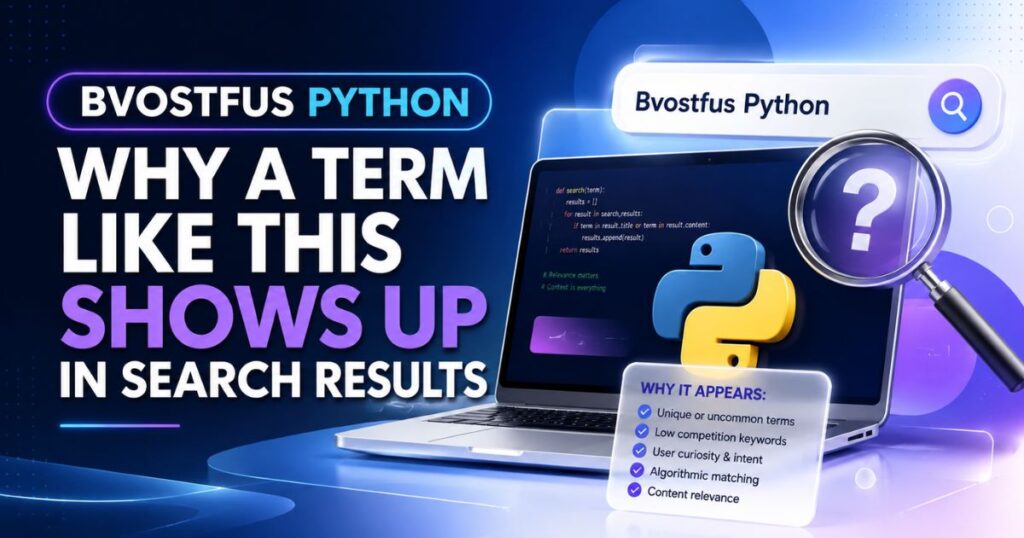
There’s no need to speculate wildly here, but a few explanations are consistent with what the research shows:
It may be AI-generated, keyword-driven content. Some websites publish large volumes of articles built around invented or obscure phrases, hoping to capture search traffic before anyone checks whether the underlying “product” exists. The near-identical phrasing and vague feature claims across multiple “Bvostfus Python” articles fit this pattern.
It could be a distorted version of a real term. Search terms sometimes originate from typos, mishearings, or autocomplete oddities. If you were trying to find a specific Python library, tool, or tutorial and landed on this term instead, it’s worth double-checking the exact name or source where you first saw “Bvostfus.”
It might reference something private or extremely niche. Occasionally a name is a real but non-public project an internal company tool, a student project, or a very small, unlisted repository. If that’s the case, it simply wouldn’t appear in mainstream research, which is different from being fabricated, but the practical advice is the same: don’t install or trust it without verification.
None of these explanations can be confirmed as the answer but all three are more consistent with the evidence than treating Bvostfus Python as an established piece of software.
Learn Related: GoralBlue com: What We Verified, What We Couldn’t, and Whether You Should Trust It
How to Verify Any Python Tool Before You Trust It
Whether or not this specific term turns out to mean something later, the verification habit is worth building:
- Search PyPI directly. Go to pypi.org and search the exact name. A real installable package will have a project page, version numbers, and a maintainer.
- Check for a GitHub repository with real activity. Look for commit history, issues, contributors, and a license file not just a polished README.
- Look for independent discussion. Real tools get mentioned organically in Stack Overflow answers, Reddit threads, or conference talks, not just in first-party blog posts.
- Be suspicious of “review” articles with no screenshots, version numbers, or specific technical detail. Vague language (“enhances your workflow,” “powerful and flexible”) without concrete specifics is a red flag.
- Never run pip install <package> for an unverified name out of curiosity on a machine you care about. If you want to experiment, use a disposable virtual environment or a sandboxed container first.
If You Were Actually Looking for Something Else
A lot of searches for oddly named “Python tools” turn out to be attempts to solve a real, common problem. A few genuinely well-documented directions, depending on what you were trying to do:
- Setting up a clean Python environment: look into venv (built into Python) or conda.
- Automating repetitive tasks: libraries like schedule, pyautogui, or the built-in os and subprocess modules are well documented on python.org.
- Managing dependencies cleanly: tools like pipenv or poetry are real, actively maintained, and widely used.
- Learning Python from scratch: the official Python tutorial at docs.python.org is free, current, and maintained by the Python Software Foundation itself.
If one of these is closer to what you actually needed, I’m glad to put together a real, verified guide for it.
Don’t Miss This: Spicy Chat AI Review 2026: What 300,000 Characters and Three Paywalls Actually Get You
FAQs about Bvostfus Python
Is Bvostfus Python safe to install?
There’s nothing to safely install, because no verified package or software by that name exists. Avoid installing anything advertised under this name until it can be confirmed on an official registry like PyPI or a known vendor site.
Is Bvostfus Python a scam?
There isn’t enough evidence to call it a scam outright most of what’s circulating looks like low-quality, keyword-driven content rather than an active attempt to distribute malware. Still, treat any “installation guide” for it with the same caution you’d apply to any unverified download.
Why do multiple websites have articles about Bvostfus Python if it isn’t real?
Search-driven content sites sometimes publish articles around trending or unusual search terms before verifying whether a real product exists behind them. Once one site publishes, others often follow, reinforcing the impression that the term is legitimate.
Could Bvostfus Python become a real tool in the future?
It’s possible that a project by this name could be released later. If credible, verifiable information appears an official repository, a documented maintainer, a real changelog that would change the picture, and it’s worth rechecking PyPI or GitHub directly at that point.
What should I do if I already tried to install something called Bvostfus Python?
If you ran an install command from an unverified guide, check what was actually installed (pip list or pip show <name>) and remove anything you don’t recognize. Running it inside a virtual environment in the first place limits any risk to that isolated environment.
Conclusion
Search results can make an unverified term look established simply through repetition several similarly worded articles create the impression of legitimacy even when none of them link back to an actual product. Based on everything checked here package registries, code repositories, official Python channels, and developer communities Bvostfus Python does not currently hold up as a real, documented piece of software. The most useful next step isn’t installing anything under that name; it’s identifying what you actually needed Python to do, and using tools that are transparently documented and verifiable.


